
The Reflected Glow of our Best and Brightest
Discovering Kiwi stars on the big stage, and what they reflect about us.

Welcome to my second article in this series on Kiwi collective culture. This series is about our little country at the bottom of the globe being discovered — and how we’re still being discovered, by others and by ourselves. It’s also about personality, both individual and collective: the parts of us we want to show and the parts we prefer to hide and avoid.
My last article — The Land of the Long White Cloud — introduced New Zealand the place, and its quirky, friendly, easy-going inhabitants. Or at least, that’s how we prefer to be seen.
This article is a story of what happens when our best and brightest are seen on the global stage — and of how we like to be seen… and not seen.

1981 was a big, big moment for us – on the big stage of music and televised show business. A quirky bunch of Kiwis had been causing a stir throughout the 70s, with their zany costumes, bizarre hair and makeup, and catchy but unconventional new-wave tunes. We weren’t entirely sure what to make of them at first; they were far removed from what our still largely conservative – and quite heavily regulated – music tastes were used to. Then we realised that overseas, people were really vibing with these boys… our boys. Split Enz.
That June, we were all a bit giddy with excitement. Split Enz1 were starring on Dick Clark’s epically famous American Bandstand. America was the epicentre of global pop culture. Sure, the Brits had phenomenal bands like Rolling Stones, Led Zepp and Pink Floyd, and the Aussies had AC/DC and Cold Chisel – but even for them, being seen and heard in America was the big deal. And American Bandstand was the epicentre, where things were hoppin’ and poppin’. And our boys were poppin’. No New Zealand flag or signature silver fern, of course, but… Split Enz. See what they did there? E–N.Z. In one clever move, they slipped our initials in there – and made it so the Aussies couldn’t thieve them, like they had with our other hit 70s band, Dragon.2
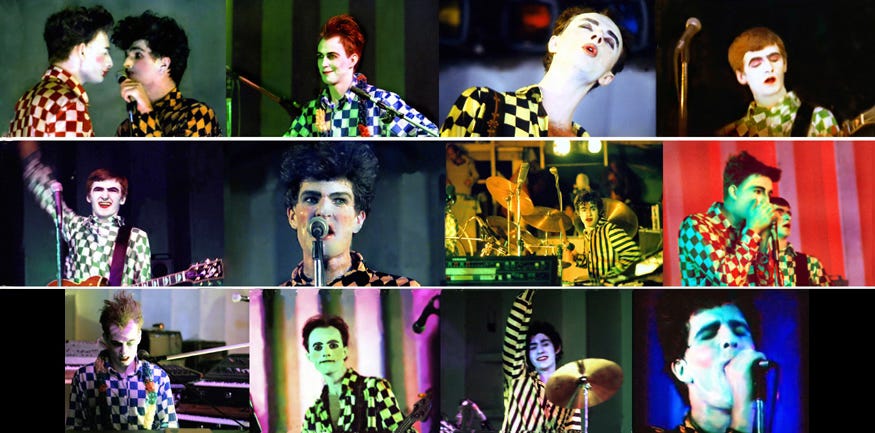

Dressed in their usual quirky attire, Split Enz played “One Step Ahead” from their latest album Waiata. And then… wait for it… they actually talked to America’s showbiz icon, Dick Clark. An American icon was talking to them – to us! This was the moment. Bated breath…
He talks to Tim Finn first, who introduces the band. We like Tim, he’s friendly, laidback, easy-going, self-depreciating – very Kiwi. Tim introduces Eddie Rayner on keys in his pink pants, Noel Crombie with his skippy beats, Nigel Griggs “our token Pom, all the way from England… we’ve allowed him to stay in the country.” We’re very welcoming like that.
(Dick) “And last but not least…?”
(Tim) “That’s Neil, my kid brother.”
And the crowd screams! Neil is very, very popular you see. Proper star. We love Neil.
Friendly Tim explains the meaning of Waiata: “It’s a Māori word. The Māori people are the indigenous people of New Zealand. They got there first, and they’ve graciously allowed us to live there… Waiata means singing, dancing, celebration – generally, really singing and dancing, which is something we like to do, and we like to spread it around.” We’re friendly like that – and our Māori culture makes us wonderfully unique. And correct Tim, Māori were here first.3
Dick turns to Neil, wanting to know more about our mysterious little corner of the South Pacific.
(Dick) “We know very, very little about your home country.”
Yep, that’s the problem, Dick – but here we are. Let us tell you, very proudly.
(Dick)“It’s a lovely, most beautiful country in the world. It’s very pastoral.”
Why thank you, Dick!
(Dick)“But there is a problem. When I was there, a lot of young people were leaving. Why is it?”
Now Dick, we’re low-key – and a little avoidant – so we’d prefer not to discuss our problems openly. We prefer the chill, easy-going persona. Tell him, please, Neil.
(Neil) “Well, it’s basically the worst place to be in the world if you’ve got any ambition, certainly as far as being a rock band.”
Gasp.
Imagine us, sitting around our telly in stunned silence. Someone drops a spoon back in the kitchen. Aunt Dolores clutches her pearls. This isn’t good. Our boys were supposed to make us look good. Worst place in the world for ambition?
(Neil) “It’s a wonderful place to have a nice, quiet time—relax, play sport, go outdoors, climb mountains, you know, fording rivers, all that sort of stuff.”
Tim and the others spontaneously burst into “Climb Ev’ry Mountain” from The Sound of Music, which lightens the mood. Tim taps into the rugged backcountry sheep-farmer exemplar, and we’re back on track.
(Dick) “Of all of these places – you’ve been to England, Japan, Australia, the United States… Would you go back to New Zealand now and make your home?”
Of course, Dick! Best-kept secret in the world down here, aren’t we, Neil?
(Neil) “Well… I think we all want to be buried there.”
WTF Neil?! You’re supposed to make us look good – but you’re making us look bad! This isn’t how we want to be seen. Who does this little punk think he is, calling us out like this? He thinks he’s better than us! A tall poppy that needs cutting down to size.
Of course, New Zealand wasn’t literally sitting around a TV watching this. No spoons were dropped, no pearls were clutched. It was months before TV broadcast tapes made it down here. Six months. Roughly. On a leaky boat. Bandstand never actually screened in New Zealand, so really, ‘I’m spinning yarn’ as we say here in NZ. Telling a tale.
But the fact is, we do indeed do this in New Zealand. We see our flag-bearers on the big global stage, with their stars was shining brightly, and we love to collectively bask in their glow. It validates us a bit as a small and perhaps still a little insecure nation. But we do gasp and clutch pearls when our stars lose their poise, or talk about the things we’d rather avoid talking about. The things we keep behind the mask. Like when we’re called out as an ambition sink-hole.
1981 was a snapshot of a time when we were still grappling with a sense of national identity that hadn’t fully formed. When our ambassadors are seen on the world stage, they need to represent us well, right? We want to be seen well. To fit in. Collectively. This places pressure on our young stars just trying to find their way, or expressing their individuality and finding their unique voice. Of course we were delighted Split Enz were doing well; most cultures are proud of their best and brightest achieving and succeeding, but there comes a point where celebrating turns into co-opting. We bask in their glow, but don’t realise it becomes less about them, and more about us. And that doesn’t appreciate who they really are, let alone understanding what’s really going on for them.
Split Enz wanted to make good music and play around the world. They were definitely being noticed – perhaps too much. On that tour, Tim was stalked by a mother and daughter in Canada. Neil, still only 23, was struggling with the glare of sudden stardom and had become more reclusive between shows. Rayner and their manager got into a skirmish. Tim, who used quirky stage banter to mask his stage fright, was in a precarious mental state and suffering panic attacks.4 What you see on stage – the outside of the mask – doesn’t always match what’s happening behind the scenes, in the shadows.
And in a way, that’s true for all of us. We learn to adapt ourselves so that we can be appreciated by others; so we can fit in and be safe, seen, and in control of our lives. But under the surface – behind the mask – we don’t feel safe, or in control, or that others will accept or flaws, defects and struggles.
Split Enz split in 1984. Neil formed his own band, The Mullanes, who in 1986 became Crowded House – who shot to superstardom beyond anything Split Enz ever achieved. Neil’s a bona fide singer/song-writing genius, so we forgave him for his little outburst, as long as we could keep calling Crowded House our own. I’m not sure if Neil agreed to that; Australia certainly didn’t. “Don’t Dream It’s Over” ranks No. 7 on APRA’s list of Top 30 Australian Songs of All Time.5 (Back off Oz!) On Triple M’s “Ozzest 100,” it’s No. 65.6 Seriously? 65th? That’s just rude.7
For me, I actually had to be out of New Zealand to realise what a big deal Neil Finn is. Music fans in the U.S. or U.K. don’t care so much where he’s from – only how good he is. They appreciate his unique talent. Ed O’Brien of Radiohead called Finn “the most prolific writer of great songs.”8 Eddie Vedder of Pearl Jam effusively of him and often collaborates in albums or onstage.9 He’s joined Coldplay onstage here.10 And Dua Lipa11. He’s like a favourite great-uncle to touring acts here.
Do us Kiwis really appreciate how our best and brightest stars like Neil Finn are seen by others? Is there still a basking-in-the-reflected-glow aspect that helps us feel a little more seen in the big wide world – and perhaps a fragile sensitivity to how we’re seen?
We’ve grown and matured a lot as a country since 1981. Thanks to artists who followed in Split Enz and Crowded House’s footsteps, more of our talent is heard abroad. Our local radio networks play far more homegrown music, and funding agencies like NZ On Air support local creatives.12 We’re no longer the “ambition sink” Finn lamented on American Bandstand.
The main point of this essay isn’t about our music industry, though – it’s about our cultural norms and values that dictate how Kiwis should – and shouldn’t – show up in the world. Neil Finn rocked the boat; he called us out and made us look bad. We forgave him – but we haven’t always been so forgiving. We love seeing our Kiwis express themselves, as long as they stay largely within our perceived and implicit cultural norms. Strong silent types are okay, as are the harmless quirky self-depreciating funny ones. You can even be a little bit irreverent or pointed, as long as we can still laugh along.
Neil was direct and blunt on Bandstand. Maybe he was just being irreverent. Maybe it just came out awkwardly. We now know that he was exhausted and struggling under the pressure of the sudden glare of fame, this introverted 23-year-old creative from a mystical little country of just 3 million that doesn’t appear on maps. Neil Finn is clearly a driven achiever – steady and usually unflappable, but assertive and forthright when needed.13 That drive made him who he is, and that emotional honesty and authenticity underpins the enormous gift of his creativity. He is a Kiwi legend.
Neil Finn wouldn’t be the last Kiwi talent to express himself under the glare of the global spotlight in a way that made us feel a bit awkward. I have some more recent examples to look at over coming weeks, where our stars popped their head above the parapet or rocked our boat, and were chopped down by their own…
I discussed the discovery of these isles in my previous post, The Land of the Long White Cloud
To be clear, I’m being tongue-in-cheek here. Crowded House formed in Melbourne, and the other two original band-members Paul Hester and Nick Seymour were Melbournian. So Australia does have a fair claim. Just don’t tell them that.
As American Country singer-songwriter Ryan Adams discovered a few years back.