
The Land of the Long White Cloud
Discovering New Zealand, collective identities, and how people and cultures turn up in the world...

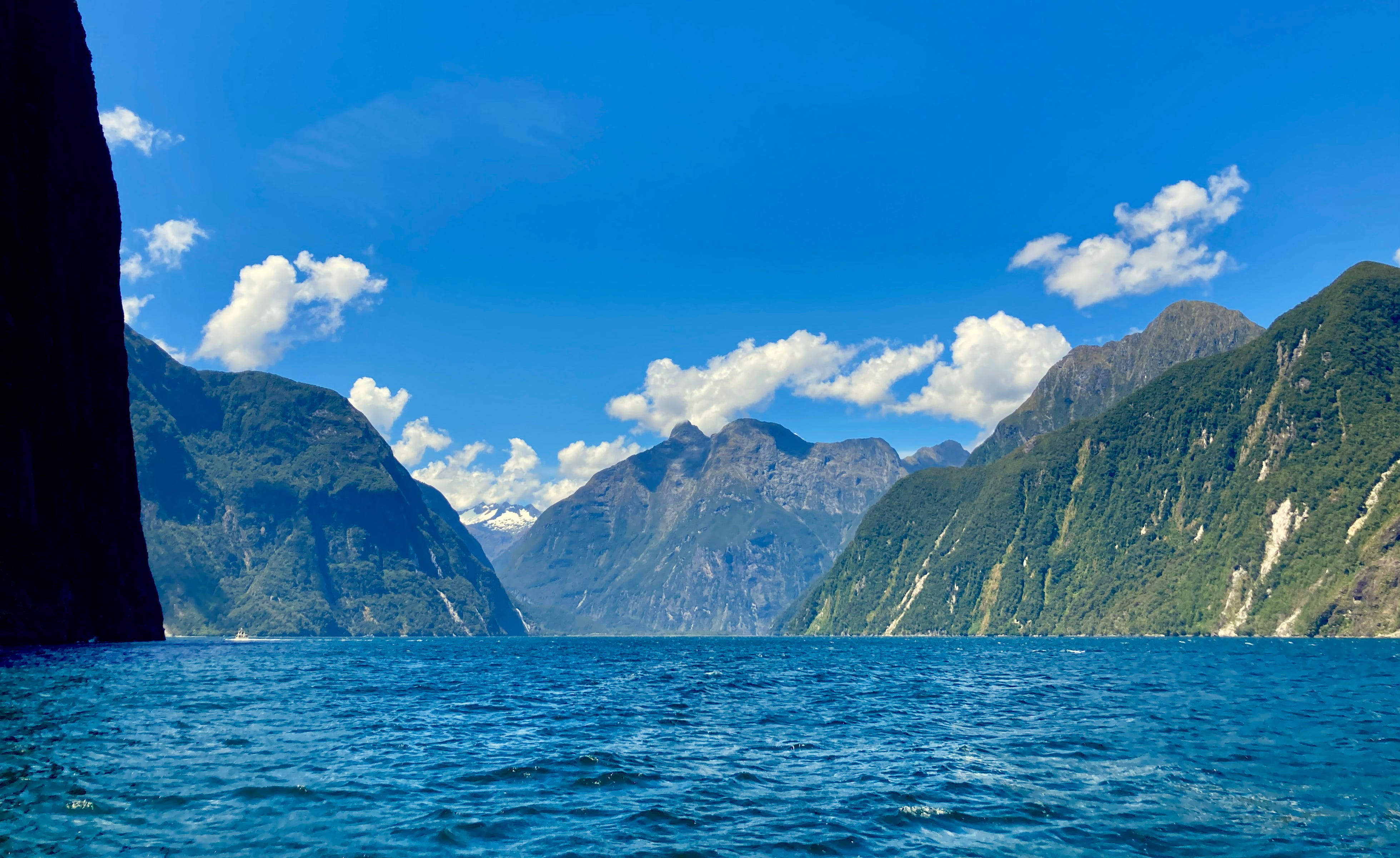
This is the first essay in a planned series exploring collective identities, culture, and personality — and how we express or hide certain aspects of ourselves to fit in. I’ll write from my own perspective, specifically as one of the many cultures now living in these isles. I am Pākehā (a New Zealander of Anglo-European descent). Although I use the broader term Kiwi — how we’re generally known around the world — I don’t pretend to speak for an entire country or to categorise an entire population based on my worldview. I write and share from my observations growing up in my little corner of the world, how it shaped me, and how I learnt to fit in.
If you’re a fellow Kiwi, you may find something that rings true — or that you disagree with. Feel free to disagree; different perspectives are valued. If you’re from overseas, you may notice patterns that help make sense of what you know about us. And if you’re Australian, please take this as tongue‑in‑cheek humour — I’m a big fan of you guys. Honest.
The Pacific Ocean is really big. There are a couple of points in the Pacific Ocean where, if you bored down directly through the centre of the earth and out the other side (its antipode), you would come out still in the Pacific Ocean. It’s vast. You can fit all the continents on Earth in it. It’s really, really big. There are lots of tiny islands and atolls spread around, explored and inhabited by early seafaring peoples. Polynesians developed remarkable ocean vessels to explore the Pacific, using their knowledge of the stars, currents and wildlife.12 They found Hawai’i to the north, Rapa Nui (Easter Island) to the south east. They landed in South America. They possibly landed in North America too, centuries before Europeans.3 But what lay to the south of this vast ocean? And who would find out?
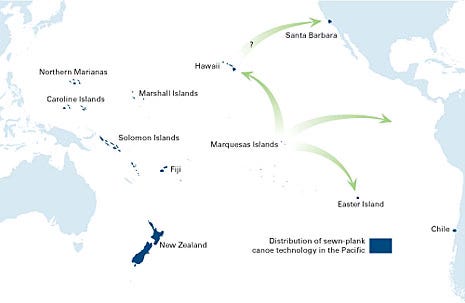
It’s said that Kupe decided to find out.4 He was convinced there was some significant land to the south. On the journey, Kupe’s wife Kuramārōtini first saw a distant cloud, “He ao!” As they drew nearer it appeared brighter, whiter. “He ao tea!” Closer still they realised it was long, surely meaning a large land. “He ao-tea-roa!” The land of the long white cloud. They had found The Great Southern Land!
Europeans found it too a bit later. They liked naming stuff after back home.
“What should we call this Land Downunder?”
“New England?”
“Nah, that’s taken. Didn’t end well for Mother England either.”
“New Wales?”
“Pretty sure there’s already a New South Wales somewhere, I forget where.”
“New Scotland?”
“Nope, there’s already a Nova Scotia, and a New Caledonia.”
“What about those distant Scottish islands, Hebrides?”
“New Hebrides is taken.”
“Seriously? Well, what about that obscure tiny Dutch island virtually no one’s heard of, Zeeland? Surely that’s not taken?”
“Let me check… It’s available! Let’s take it! We have found New Zealand!”
To be fair, a Dutchman was the first European to ‘discover’ this land. It was a slightly awkward encounter. It seems we’ve always done awkward quite well down here. It’s become part of our self-effacing comedic schtick. Comedians like Billy T James made a living out of this.
Except this first awkward encounter wasn’t very funny.
In December 1642 Abel Tasman and his crew aboard the Heemskirk sailed into a beautiful cove at the north end of the southern major island. The locals perhaps weren’t sure about this weird, large, sailed sea vessel and its strangely white-skinned crew. Stay wary. Tasman and his crew likewise weren’t sure of the natives of this land, very wary. Friend or foe? The locals blew their pūtūtara conch-shells, used for announcing, warning or welcoming. The Dutch assumed “definitely foe!” and responded with their own battle horns. And a cannon. Things escalated a bit. One of the small Dutch landing boats was rammed by a canoe, four Dutch crew killed, one Māori. The rest of the landing party escaped back to the Heemskirk and high-tailed back off to sea. Tasman never set foot on the land that would later bear a Dutch name. Tasman named that bay Moordenaers Baij, ‘Murderers Bay’.5
Of course, it was the English who ‘proper discovered’ this land. Captain James Cook and his crew on the Endeavour (with a little help from Polynesians who had already discovered this land)6 sailed into our easternmost part of our northern island in October 1769. A 12-year-old Nicholas Young first spotted a peninsula, now named Young Nicks Head, near today’s city of Gisborne. They sailed into a broad bay to meet those who had been here for centuries. The locals again tried to communicate as per their custom, Cook responded with guns. This time locals’ blood was tragically spilt. In the end Cook wasn’t that impressed and left to find a different spot. He named that place Poverty Bay. He named many other places too; many places still bear his name.7
Still finding New Zealand…
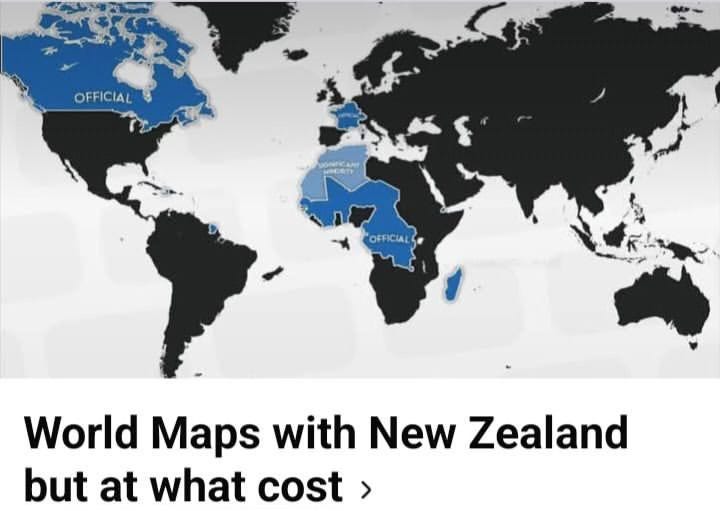
New Zealand is still being discovered in many ways. Despite Cook’s 18th century discoveries, many 20th century world maps still leave us off completely. Britain must be the centre of world maps, which places us at the bottom right corner. Maybe they ran out of space. Or ran out of ink, after drawing the continental-sized mound of red dirt to our west. But that’s cool, we don’t want to make a fuss.

Kiwis (as we’re known, after our quirky native flightless bird) don’t make a fuss. We’re pretty chill, friendly, easy-going, with a funny (dry, sardonic, and admittedly a bit awkward) sense of humour. We all get along, no big-heads here. Very flat, egalitarian. You’re welcome to come visit (if you can find us).
Rhys Darby, our king of quirky, kiwi comedy, was recently on a foreign chat show (not sure where, possibly that South Wales place?). On a reel titled “Are New Zealanders the Nicest People on Earth?” Darby is asked “What is it about that New Zealand sensibility you think that has just worked so well around the world?”
“I think it’s sort of a naïve optimism. We’re novelty, but we’re a breath of fresh air… for the Americans to hear these voices, and a lot of them didn’t even know where New Zealand was (still don’t!)… but it’s joyful, you know, we don’t punch down. I mean, as New Zealanders we barely punch!” (Rhys Darby)
That’s our Rhys. And it’s Kiwis in general right? Easy going, quirky, self-deprecating, witty. Or at least, that’s the stereotypical, cultural norm.
So when we’re left off a world map, we just laugh it off, right? No big deal. It’s okay that the Smithsonian or Ikea don’t include us on their big walls. No stress. When the boardgame Pandemic came out in 2008 they only got as far as that New Wales place too, no New Zealand, but that’s cool. Actually, when the real pandemic came out that worked out pretty good for us. Our little team of 5 million stamped Covid out and went back to what we were doing, aided by our 1200-mile-wide moat.8 Of course we were concerned about what the rest of the world was enduring, but we were quite happy not being seen. I mean, we’re okay with not being seen, right? Nicest people on earth and all.
Masking…
Personality comes from the Latin word ‘mask’. Persona is a thing we put on; it’s how we present ourselves to the world. How we fit in. Of course this primarily relates to individuals’ personalities, but there’s also such a thing as ‘collective personality’. Obviously not everyone in a culture has the same, or even a similar, personality, but we are shaped by collective forces and collective norms from the society around us. This varies from place to place. Social do’s and don’t’s shape and perhaps confine our expression. While we want to avoid stereotyping, broad patterns do emerge that do say something about our place in a culture.
A mask has two sides: the side facing out, that others see; and the side facing in, that only we see, or that some close to us see when the mask slips. The shadow side of personality. The parts we hide.
You’ll perhaps have noticed my subtle digs at our nearest neighbours Australia. For any Australian readers who haven’t yet given up on this post in disgust, Hi! For the record, I love Australia. It’s a beautiful country. Very big. And I love Australians generally. In the rest of the world, they’re more like us than anyone else. We have a strong shared history. We help each other out when needed. Aussies have a similar sense of humour, and we get a kick out of ribbing each other. And more than anyone they see beneath our easy-going, friendly, self-deprecating mask.
You see, we don’t actually like being left off world maps. It makes us a bit grumpy to be honest. We don’t express it outwardly of course, heaven forbid. We’re quite avoidant like that. Attachment issues from distant Mother England perhaps. Instead we quietly compile lists of offending maps and share it amongst ourselves with a passive disdain.9 We really really do want to be seen by the big wide world, but just not seen as cranky or bitter. We hide that. We want others to see us as friendly and chill, like Rhys Darby. Or strong-silent types who get the job done and don’t rock the boat. Boat-rockers might get cast adrift.
Australia sees behind the mask a bit more though. It’s a bit like a sibling rivalry for us with them, except they’re way bigger than us. And more seen than us. People know where Australia is. It’s massive. And red. Space Station astronauts know when they’re above Australia without looking out their window. Their cabins glow red.10 Aussies carry a bit more confidence than us too. We hate to admit it, but they’re also better than us at most sports, although we gloat when we beat them. Or twist the metrics a little bit to make it sound like we’re beating them. Per Capita Olympic Medals table anyone?11
Aussies love stealing our favourite things too. We keep lists of these things too. From desserts to sportsmen to our favourite bands, they nick our things just like big siblings do.
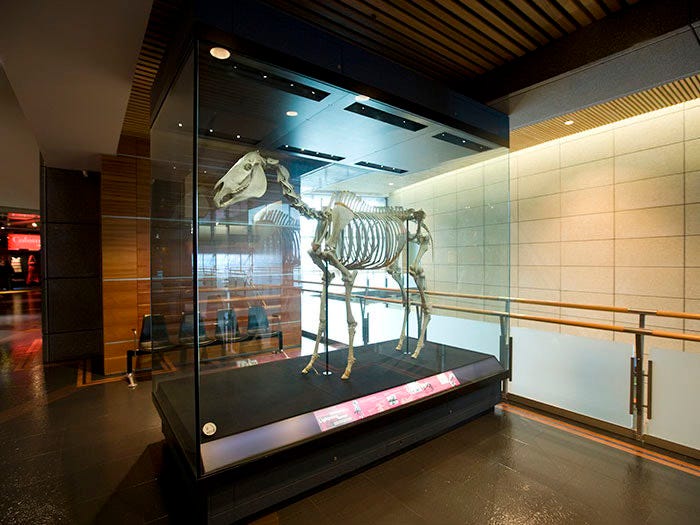
Like Phar Lap, the great racehorse who, in November 1930 at the famous Melbourne Cup, despite being dead last around the final corner, stormed through the field to a famous win. So famous there’s a bronze statue of him outside Melbourne’s Flemington Racecourse. Aussies love champions. We point out he was born in Timaru in the South Island of New Zealand, so he’s our champion. Aussies claim he was purchased by an Aussie trainer as a rough diamond, then developed and trained to be a world beater in Australia. We say if horses could speak, he’d say he’s Kiwi. They say we’re dreaming, and New Zealand had no racing industry, and horses don’t talk. We point out that it figures that they thieve stuff, because they were a convict colony, and then we’re rolling around fighting on the back lawn. Play fighting of course. We do love each other. But Phar Lap’s Kiwi. We have his bones.12 (They still have his hide, which is weird frankly, but there you go).
Tall Poppy Syndrome…
I’m going somewhere with this by the way. With personality, individual and collective, there’s always two sides to the mask. Us Kiwis like to project friendly, easy-going self-deprecating, but I think we also enforce that on each other here. Internally. We don’t like big-heads or class structures. We like our people to stay cool and calm and not rock the boat. You can succeed and excel, but not too much. Don’t think you’re better than the rest of us. Don’t be a tall poppy. We call that Tall Poppy Syndrome.
Australia has a version of tall poppy syndrome too. They’d prefer their best and brightest stay humble and easy-going, but they love their winners too. They love a good Aussie champ, and they don’t mind a little bit of Aussie snarl, that true-blue Aussie battler. That’s why they’re so damn good, they’re ruthlessly competitive. And perhaps because they grew up in a land crawling with things that’ll eat you.
We like winners too, but our winners have to stay cool, calm and collected. Strong, silent types. Don’t pop your head above the parapet, with strong opinions or brashness. You’ll make us look bad. No snarl please. Either be friendly and easy-going, or a strong, silent type. You can be funny, but don’t laugh at your own jokes. Don’t be brash, and definitely don’t rock the boat. You’ll get cut down to size. We’d prefer you stayed average than be a tall poppy. Ol’ Rhys reckons us Kiwis don’t punch down. Don’t even punch. But we do cut down. Or press down perhaps, more subtly. A darker undercurrent.
You may disagree with me. That’s cool. I have a few examples I’ll share moving forward to show my point. Examples of our best and brightest who fit that easy-going or strong-silent mould. I’ll call them ‘Exemplars’. Without realising it, generations of Kiwi kids looked up to these exemplars as the types to aspire to.
I’ll also give a few examples of Kiwis who’ve broken that mould over the years too. I’ll call them ‘alter-heroes’. As far as I’m aware, that’s my phrase. They’re not anti-heroes, that classic character type that is flawed or even bad but still ends up doing good. My alter-heroes aren’t so much flawed as just different from that classic ‘type’. I think these alter-heroes not only teach us we can be different, but that these differences are truly valuable to our culture. We need them, and need to recognise and value them. They add something diverse and redemptive to our story. We are all different, and that should be celebrated, not conditioned out of us.
I also think this teaches us about human personality more widely. This isn’t just about Kiwis; that’s perhaps just a case study on how humans turn up in the world in diverse ways. Every person is unique and different, with different experiences and stories and cultural forces shaping them. But we’re also somewhat predictable. Patterns and currents emerge that can help us see what’s going on, and by observing these we can learn and grow. We can ask better questions. There’s an invitation here, for individuals and cultures.
At the end of the day though, I’m only writing from my perspective. All of what I write about growing up is how I’ve perceived it, from my location. My little corner. I try to observe, listen and learn from other perspectives, but I still unwittingly filter them through the lens I grew up with. We all do. As a child of the late 70’s, with my memories of growing up in a small, rural Kiwi town in the 80’s and 90’s, I can see how this collective, cultural psyche shaped me. How I unconsciously strived to be like those strong-silent types, or easy-going cruisey ones. I’ve come to see how I’m not like that though, I’m far more sensitive, expressive and heart-driven than that. I’m now relearning that these differences are gifts, and we gain so much from each other’s authentic expressions. That starts with me expressing what I’ve seen and noticed, and what I imagine growing could look like for all of us.
https://e-tangata.co.nz/history/the-supreme-navigators-of-history
https://natlib.govt.nz/schools/tuia-matauranga/voyaging-through-nz-histories/pacific-navigation
https://www.history.com/articles/polynesian-sailors-americas-columbus
https://www.latimes.com/archives/la-xpm-2005-sep-06-os-briefs6.2-story.html
To be clear, my ancestry is not from Kupe or Māori, so I try not to pretend to tell his/their story accurately. This is based on what I’ve been told, with the following links as guides…
https://teara.govt.nz/en/first-peoples-in-maori-tradition/page-6
https://www.linz.govt.nz/our-work/new-zealand-geographic-board/place-name-stories/maori-oral-history-atlas/kupe-discoverer
https://teara.govt.nz/en/european-discovery-of-new-zealand/page-2
https://www.waitangi.org.nz/waitangi-blog/abel-tasmans-arrival-in-nz
https://www.nzgeo.com/stories/tupaia/
https://teara.govt.nz/en/biographies/6t2/tupaia
250 years later, we’re still grappling with the way this story has been told, and by who. Māori iwi are telling the story of that cultural collision from their perspective, one we’ve heard much less from, especially in my formative years… https://www.rongowhakaata.iwi.nz/karanga-pakura/collsion
This short video by two Pākehā filmmakers with Radio New Zealand (RNZ) attempts to tell the story more honestly, including the bits we’ve preferred to perhaps avoid….
https://www.voanews.com/a/covid-19-pandemic_world-isolates-amid-coronavirus-pandemic-new-zealand-band-plays-50000-fans/6205016.html
https://www.stuff.co.nz/travel/destinations/nz/76931981/New-Zealand-is-being-left-off-world-maps
https://www.stuff.co.nz/nz-news/360703494/nz-left-world-map-again
https://www.rnz.co.nz/life/books/why-does-new-zealand-keep-disappearing-from-world-maps
https://www.reddit.com/r/MapsWithoutNZ/
Actually. As told by US Space Station Commander Terry Virts in his book View From Above. https://www.amazon.com.au/View-Above-Terry-Virts/dp/1426218648
https://www.rnz.co.nz/news/media-technology/524896/the-kiwi-brain-behind-the-paris-olympic-s-medal-per-capita-tally
https://www.tepapa.govt.nz/visit/exhibitions/phar-lap
Loved the read. Agree, many maps forget us. Even where I'm living here, maps forget us.
Love the perspective, especially from a listener, observer and introvert.